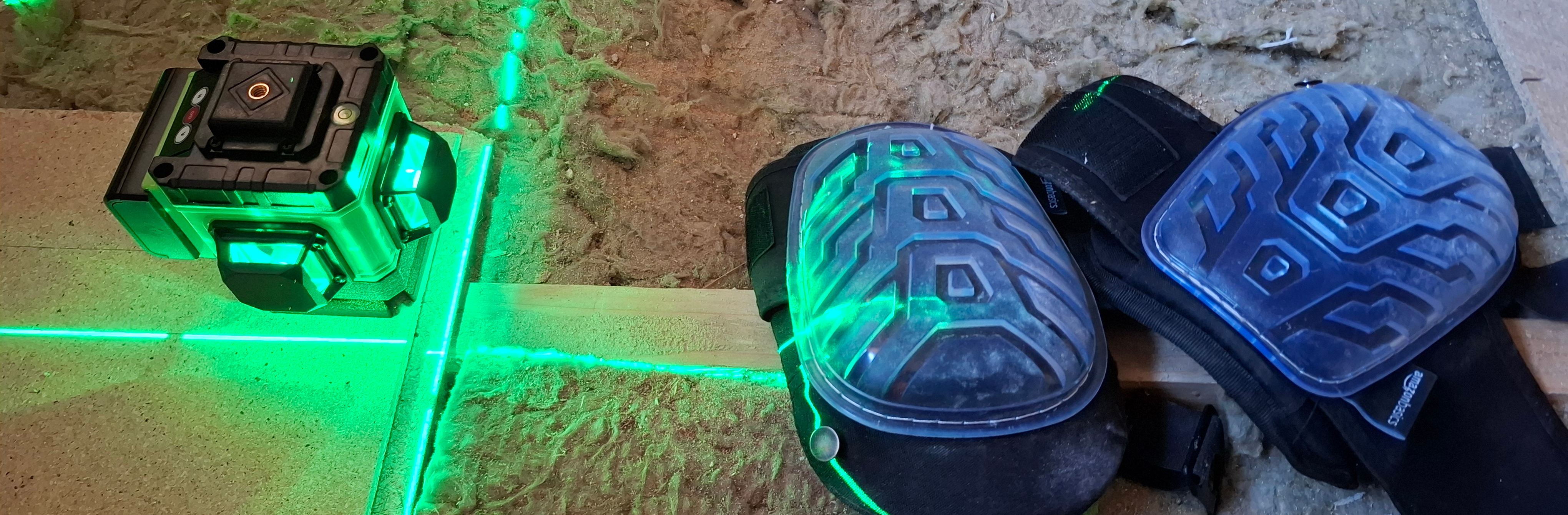
360° laser is awesome
In case you’ve never used a laser level, you might be wondering why all builders use it. After all, all it does is make a line on the wall. A pencil can do the same.
What they give is speed and precision. It’s true they don’t unlock any new possibilities. The same things can be done with a pencil, bubble level and a square. But such measurement takes several minutes instead of seconds, and if you do it dozens of times per day, the time saving is huge. They’re also more precise, as the tiny errors from repeated measurements don’t accumulate.
Types of laser levels
Basic laser level
It almost disappeared from the market: just a bubble level that displays a laser line to extend the reach. You need to level it manually. Not very useful.
Self-levelling cross-laser
It displays a horizontal and vertical line onto whatever surface it’s pointing at. That’s already useful: you need horizontal lines, vertical lines and 90° angles for all sorts of tasks. But check the next one.
360° laser level
It projects a line that wraps all the way around the room. Most have 2, 3 or even more lines. I recommend a 3x360° version to display lines in all 3 planes. All devices I’ve seen are self-levelling. You can lock the levelling mechanism if you need diagonal lines.
How to use them
Put it on a tripod, set it close to horizontal, it will settle to completely horizontal in a second or two (or beep if it can’t - the mechanism only works when it’s no more than a few degrees off). Adjust the tripod height and position to display the lines wherever you need them. You can use the lines directly to align something, you can draw over them, take measurement of them, it all depends on the use case.
The 360° version is much better if you need a line on the same height on more than one wall. With a cross laser, you would need to mark on the first wall, rotate, mark again and hope you didn’t accidentally move the device.
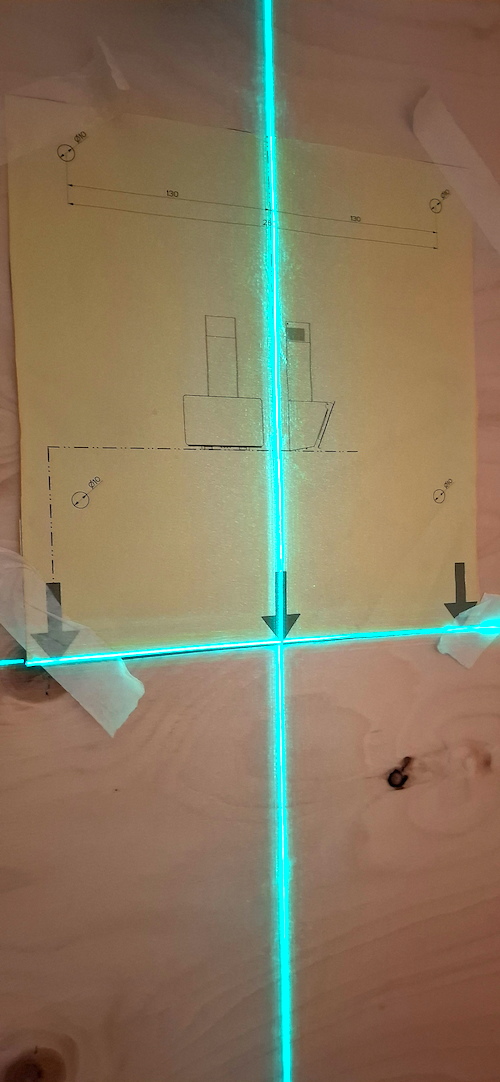
The ceiling problem
This is where the 3x360° really shines (pun intended). Have you ever tried to mark a point on a ceiling, while standing on a ladder and trying to reach walls with a flopping tape measure? I have. Don’t ask me about the accuracy.
With the laser, you can measure everything on the floor, mark the point, put the crossing lines over it, and the other crossing lines are directly above the first point.
Typical home uses
Wall tiling: Setting out the first level course of tiles across multiple walls is exactly what 360° lasers are made for. Project the reference line once, tile to it across all walls.
Kitchen fitting: Wall cabinets at a consistent height, worktop level checks, top cabinets perfectly aligned with bottom cabinets - having reference lines speeds up layout considerably.
Skirting boards: Mark the height all the way around in a single pass rather than measuring from the floor at dozens of individual points. But remember the floor is not always completely flat - decide if you need your line perfectly level or the same distance from the floor.
Hanging multiple pictures or shelves: If you want a row of frames or shelves to sit at exactly the same height across a wall, the laser line gives you a continuous reference to work to.
Partition walls: Project a vertical line from floor to ceiling to mark the place before you start building.
Fitting lights: See the ceiling problem above.
Measuring in awkward places: Similar to the ceiling problem: sometimes a place you need to measure is partially obstructed, but the opposite wall is available.
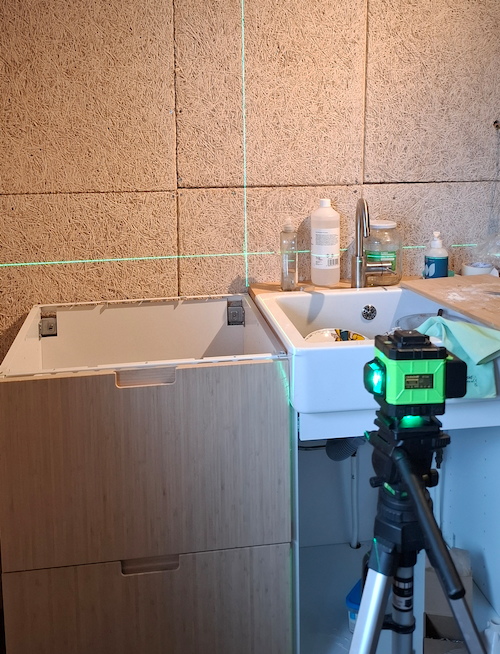
Choosing a model
Number and type of lines
3x360°, definitely. Anything less is only half as useful. More is not needed for home use.
Brands
A few years ago, only expensive devices from brands such as Bosch or DeWalt were available. Today, Chinese brands such as Huepar or Clubiona give the same results for much less. Possibly, those tools are less durable, but for home use, you can be cautious.
Green vs red laser
Green is significantly more visible to the human eye in brighter conditions. Red is cheaper. Most brands switched to green lasers anyway, but if you have an older device, red is fine for home use.
Mounting
Many units come with a small adjustable base for placing it close to the floor and a magnetic base for attaching to metal objects. Some also come with a tripod, which is needed for probably 99% of tasks. But if you’re into photography, you already have it; if not, it’s easy to get one. Even the cheapest tripod that’s not stable enough for photography, works fine for laser levels.
Battery
Most devices these days come with a rechargeable li-ion battery pack. Some use AA batteries or similar, some use power tool batteries. For occasional home use, any version works. Professionals who need many hours of continuous work might have a different opinion.
What I got
Clubiona IE12A. Chinese, but reputable brand, 3x360°, green laser. Red would also do, but Clubiona and Huepar don’t make them anymore and I didn’t want to buy an unknown brand. It came with a small base and a magnetic mount, I haven’t used them yet - I use it with a photography tripod I already had. One battery pack, but it lasts for months of my use. Also comes with a remote, which is very useful. It’s quite bright, I actually always start with reducing intensity (it always powers on at full brightness).
A few practical notes
Eye safety
Most laser levels are Class 2 devices, which means the natural reflex to blink or look away is enough to protect your eyes (only some expensive models for outdoor use are more powerfull Class 3R). Brief accidental exposure is safe, intentionally staring into the laser is not. Quite similar to looking at the Sun. There’s no need for eye protection, just some basic caution: don’t shine it into anyone’s eyes, keep away from children, don’t look at it with optical instruments.
Accuracy
If you measure over a long distance - say, 10m - there will be a 1-3mm difference. It’s still much better than could be reasonably achieved with traditional tools, and within tolerance for most uses. If you need more precision, you have to spend significantly more on your device and calibrate it frequently.
Range
Even bright green laser lines become hard to see past about 10-15 metres in bright light. Some models come with a receiver which detects where the line is even if it’s not visible to the naked eye. For home renovation, you won’t need the receiver.
You still need a bubble level
Despite the enthusiasm above, a spirit level is always within reach during home renovation. For small surfaces, tight spaces, small tasks where setting up a tripod wouldn’t make sense. Occasionally, e.g. when fitting kitchen cabinets, I used both to take multiple measurements, in all planes and in many places.